

When comparing Buy-to-Let mortgages, it is natural to focus on the interest rate and product fee.
A mortgage with a higher fee can immediately look more expensive. But for some landlords, particularly those looking to maximise borrowing, the opposite can be true.
Choosing a Buy-to-Let mortgage with a higher product fee can sometimes provide access to a lower interest rate. And because of the way lenders assess rental affordability, that lower rate may allow you to borrow significantly more.
 Why Buy-to-Let Borrowing Works Differently
 Why Buy-to-Let Borrowing Works Differently
With a residential mortgage, lenders usually focus heavily on your personal income and expenditure when deciding how much you can borrow.
Buy-to-Let mortgages are different.
Although lender criteria vary, the amount you can borrow is often influenced by the rental income the property generates.
Lenders typically apply an Interest Coverage Ratio (ICR) calculation. In simple terms, they want the expected rent to cover the assessed mortgage interest by a certain percentage.
Depending on the lender and your circumstances, the calculation can be affected by factors such as:
🏠 The monthly rental income
📉 The mortgage interest rate
🧮 The lender’s stress rate
💷 Whether you are a basic or higher-rate taxpayer
🏢 Whether the property is owned personally or through a limited company
🏘️ The type of Buy-to-Let property
📊 The loan-to-value (LTV)
This is where the product fee can become important.
How Can a Higher Fee Increase Your Borrowing?
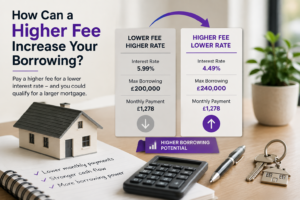 How Can a Higher Fee Increase Your Borrowing?
Some Buy-to-Let lenders offer products with higher arrangement fees in return for lower mortgage interest rates.
At first glance, paying a larger fee may seem unattractive.
However, if the lender uses the product’s actual interest rate, or a stress calculation influenced by that rate, when assessing rental affordability, a lower rate can improve the rental coverage calculation.
That can potentially increase the maximum mortgage available.
Worked example
Imagine a landlord wants to remortgage a rental property and the monthly rent is £1,500.
They compare two mortgage products.
Product A has a relatively low arrangement fee but a higher interest rate.
Product B has a considerably higher arrangement fee but offers a lower interest rate.
If the lender’s affordability calculation is linked to the mortgage rate, Product B could produce a stronger rental affordability result.
The landlord might therefore be able to borrow more with Product B, despite paying the higher fee.
For an investor trying to release equity for another property purchase, restructure a portfolio or refinance existing borrowing, that additional borrowing capacity could be far more important than simply choosing the mortgage with the lowest upfront fee.
Higher Fees Do Not Automatically Mean a Better Mortgage
 matically Mean a Better Mortgage
This does not mean landlords should always choose the mortgage with the highest fee.
Far from it.
A higher-fee mortgage only makes sense when the overall numbers and your objectives justify it.
For example, suppose one mortgage allows you to borrow an additional £30,000 but carries a substantially larger arrangement fee.
If that extra £30,000 enables you to complete another property purchase or achieve an important refinancing objective, the higher fee may be commercially worthwhile.
But if you do not need the additional borrowing, paying the higher fee could be unnecessary.
The important question is not simply:
“Which mortgage has the lowest fee?”
It is:
“Which mortgage gives me the right combination of borrowing, interest rate, fees and overall cost for what I am trying to achieve?”
Product Fees Can Be Significant
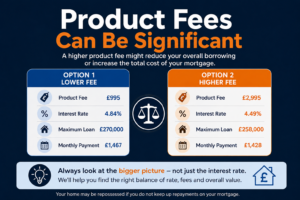 Product Fees Can Be Significant
Buy-to-Let product fees can be structured in several ways.
Some lenders charge a fixed amount, while others calculate the fee as a percentage of the mortgage.
For example, on a £250,000 Buy-to-Let mortgage:
💷 A 2% fee would be £5,000
💷 A 5% fee would be £12,500
💷 A 7% fee would be £17,500
That is why the fee should never be considered in isolation.
You need to understand what you are receiving in return for paying it.
A higher fee could potentially provide a lower rate, improved rental affordability or greater borrowing capacity. But the overall cost still needs to be assessed carefully.
This Can Be Particularly Relevant for Portfolio Landlords
 his Can Be Particularly Relevant for Portfolio Landlords
The calculation can become even more important for experienced property investors.
You may be looking to:
✅ Release equity from an existing Buy-to-Let property
✅ Raise a deposit for another investment
✅ Refinance borrowing
✅ Expand an existing property portfolio
✅ Purchase through an SPV limited company
✅ Improve portfolio cash flow
✅ Restructure borrowing across several properties
In these situations, maximising borrowing can sometimes be more important than securing the mortgage with the smallest arrangement fee.
The cheapest-looking mortgage is not necessarily the mortgage that best supports your wider investment strategy.
Limited Company Buy-to-Let Mortgages
 Limited Company Buy-to-Let Mortgages
Higher product fees are also commonly encountered in the specialist Limited Company Buy-to-Let market.
If you purchase or hold investment property through an SPV limited company, the choice of lender and product can make a substantial difference to the borrowing available.
Two lenders looking at exactly the same property and rental income can produce very different maximum loan amounts because their rental calculations, stress rates and lending criteria differ.
This is one reason specialist Buy-to-Let mortgage advice can be valuable.
It is not simply about finding a low rate. It is about understanding how different lenders assess the whole transaction.
A Lower Rate Is Not Always the Cheapest Option
 ot Always the Cheapest Option
There is another important consideration.
A product offering the lowest interest rate can still cost more overall once the arrangement fee is included.
This is particularly relevant if you are borrowing a relatively small amount or only expect to keep the mortgage for a short period.
When comparing Buy-to-Let mortgages, I therefore look beyond the headline rate and consider factors including:
💷 Maximum borrowing available
🗓️ Monthly mortgage payments
🧾 Product and arrangement fees
➕ Whether fees are added to the mortgage
⚠️ Early repayment charges
🏠 Rental affordability calculations
📊 Overall cost during the initial mortgage period
🏘️ Your plans for the property and wider portfolio
It is the combination of these factors that matters.
The Right Mortgage Depends on Your Objective
 The Right Mortgage Depends on Your Objective
There is no single “best” Buy-to-Let mortgage.
For one landlord, keeping upfront costs as low as possible might be the priority.
For another, releasing the maximum amount of equity could be far more important.
And for a property investor planning another purchase, paying a higher product fee could potentially be worthwhile if the resulting mortgage releases the capital needed for their next investment.
That is why I believe Buy-to-Let mortgages should be considered as part of the landlord’s wider strategy rather than simply compared by headline interest rate.

Looking to Maximise Your Buy-to-Let Borrowing?
If you are a landlord, property investor or portfolio landlord in Carmarthen, West Wales or elsewhere in the UK, I can help you compare Buy-to-Let mortgage options across both mainstream and specialist lenders.
Whether you are purchasing your next investment property, refinancing an existing Buy-to-Let, raising capital or investing through an SPV limited company, I can assess which lenders may offer the borrowing you need and explain the true cost of the available options.
The lowest fee is not always the best deal — and sometimes paying a higher fee can unlock the borrowing needed to move your property investment plans forward.
If you’d like to discover how a limited company Buy-to-Let could help you grow your property portfolio and secure long-term financial success, book your complimentary consultation today.