

For many company directors, income isn’t as straightforward as receiving a monthly salary.
You may take a relatively small PAYE salary, with the remainder of your income coming from dividends. Your company may also make pension contributions on your behalf.
That can work well financially, but it can create a potential problem if illness or injury prevents you from working.
Would your current income protection actually replace enough of the income you rely on?
Executive Income Protection is designed specifically for businesses and can provide an alternative to arranging income protection personally
 What Happens If a Director Can’t Work for 6 Months?
 What Happens If a Director Can’t Work for 6 Months?
As a company director, your personal and business finances are often closely connected.
Your income may include:
💷 PAYE salary
💰 Dividends
🏦 Company pension contributions
🎁 Other benefits provided through the company
If illness or injury stopped you working tomorrow, what would happen?
❓ Could you continue paying your mortgage and household bills?
❓ Would you need to use your savings?
❓ Could the business continue paying you?
❓ What would happen if your absence affected company revenue?
For many directors, the financial consequences of being unable to work could extend well beyond simply losing their monthly salary.
That is why income protection for company directors needs to be considered differently from protection for a conventional PAYE employee.
Why Standard Income Protection Can Fall Short for Company Directors
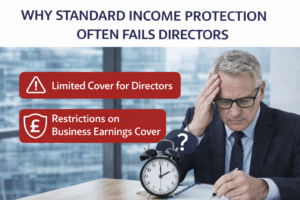 Why Standard Income Protection Can Fall Short for Company Directors
Personal income protection is generally based on your eligible personal earnings.
This can potentially create a problem for directors who deliberately take a modest PAYE salary and receive additional income through dividends.
For example, a director could have:
💷 A relatively low PAYE salary
💰 Significant dividend income
🏦 Company pension contributions
🏠 A lifestyle based on their overall income rather than salary alone
If protection is arranged without considering how that director is remunerated, there could be a significant difference between the income they normally receive and the amount their protection plan could provide.
❌ Having income protection doesn’t necessarily mean you have enough income protection.
The important question is whether you have the right type and level of protection for the way you take income from your company.
The Financial Risk Company Directors Often Underestimate
 The Financial Risk Company Directors Often Underestimate
Imagine being unable to work for six or twelve months because of a serious illness or injury.
Few of us could have predicted COVID-19 or how quickly it would disrupt everyday life and businesses. It was a powerful reminder that circumstances can change unexpectedly, even for successful and well-run businesses.
The same applies personally. An unexpected illness or injury could prevent you from working for months, potentially affecting both your personal income and the business that depends on you.
Your financial commitments don’t disappear.
You could still have:
🏠 Mortgage or rent
💡 Household bills
👨👩👧 School or childcare costs
💳 Loans and other financial commitments
🛒 Everyday living expenses
At the same time, your company could lose some or all of the revenue that depends on your involvement.
This is particularly important for owner-managed businesses where the director is also one of the main people responsible for generating revenue.
Having cash in the business doesn’t necessarily solve the problem either.
Using company reserves to support your personal finances could reduce the money available for:
❌ Staff salaries
❌ Suppliers
❌ Business investment
❌ Unexpected costs
❌ Future growth
What Is Executive Income Protection?
 What Is Executive Income Protection?
Executive Income Protection is an income protection plan taken out by a business to protect an employee or director.
🏢 The company arranges the protection
💷 The company pays the premiums
🛡️ The director is the person being protected
If the insured director becomes unable to work because of an eligible illness or injury and meets the insurer’s definition for a claim, the plan can provide a regular benefit following the agreed deferred period.
The company can then use the benefit to help maintain the director’s remuneration, subject to the terms of the plan and applicable tax rules.
Depending on the insurer and individual circumstances, it may also be possible to take account of more than just PAYE salary when establishing the appropriate level of cover.
✅ This can make Executive Income Protection particularly relevant for limited company directors.
Executive Income Protection: Tax Considerations
One attraction of Executive Income Protection is that the premiums are paid by the company rather than personally by the director.
Depending on the circumstances, premiums may be treated as an allowable business expense for corporation tax purposes.
However, the tax treatment will depend on the structure of the arrangement and the individual circumstances of the business.
There can also be tax implications when benefits are paid following a successful claim.
⚠️ Executive Income Protection should therefore not be selected purely because of potential tax advantages.
The priority should be establishing an appropriate level of protection and ensuring the arrangement is suitable for both the director and the business.
Tax treatment depends on individual circumstances and may be subject to change. Appropriate tax advice should be sought where required.
Personal vs Executive Income Protection – What Is Right?
 Executive Income Protection – What Is Right?
There are some important differences.
👤 Personal Income Protection
✅ You arrange the protection personally
✅ You pay the premiums personally
✅ Designed to replace part of your eligible personal income
⚠️ Dividend income may require careful consideration
⚠️ A low PAYE salary can potentially affect the amount available
Personal Income Protection can still be perfectly suitable for many company directors.
🏢 Executive Income Protection
✅ The company arranges the protection
✅ The company pays the premiums
✅ Designed for employees and directors
✅ May better reflect certain director remuneration structures
✅ Can potentially include additional elements of remuneration, subject to insurer criteria
Neither option is automatically better.
The right solution depends on how you are paid, how much protection you need, your existing arrangements and the financial position of your business.
A Typical Company Director Scenario
 A Typical Company Director Scenario
Consider a company director receiving:
💷 £12,570 PAYE salary
💰 £40,000 annual dividends
🏦 £10,000 annual company pension contributions
Their lifestyle clearly isn’t based solely on a £12,570 salary.
Their overall remuneration from the business is considerably higher.
If income protection were arranged without properly considering how the director takes money from the company, there could potentially be a significant protection gap.
❌ Simply looking at salary may not tell the whole story.
✅ This is why I look at the whole picture.
That includes:
🔹 How you take income from your company
🔹 Existing protection arrangements
🔹 Personal financial commitments
🔹 Company pension contributions
🔹 The monthly benefit you need
🔹 How long you could manage before payments need to begin.
Is Executive Income Protection Right for Your Limited Company?
 Is Executive Income Protection Right for Your Limited Company?
Executive Income Protection may be worth considering if you are:
🔹 Are a limited company director
🔹 An owner-manager of a limited company
🔹 Taking a combination of salary and dividends
🔹 Receiving employer pension contributions
🔹A key income generator within your business
🔹 Concerned about maintaining your income during long-term illness or injury
It can be particularly relevant where the financial wellbeing of the director and the business are closely connected.
Why Specialist Protection Advice Matters
 Why Specialist Protection Advice Matters
Executive Income Protection isn’t simply about finding the cheapest monthly premium.
Different insurers can take different approaches to:
💷 Eligible earnings
💰 Dividend income
🏦 Employer pension contributions
📊 Maximum benefit levels
⏳ Deferred periods
📋 Claim definitions
🩺 Medical underwriting
👔 Occupation classes
The cheapest protection plan may not provide the most appropriate solution.
When I advise company directors, I look at how you take your income, what you need to protect and how the protection fits alongside your wider personal and business finances.
The objective is simple:
🛡️ If illness or injury prevents you from working, you want the protection you’ve arranged to be designed around your actual circumstances.
 Protect the income your business depends on